
Skip to content
Vaulthalla LogoVaulthalla

Self-hosted S3

An S3 endpoint on your own hardware

Give AWS CLI, boto3, rclone and MinIO mc an endpoint backed by encrypted vaults on your own disks. Every bucket is a vault, so the same files show up in Finder, a mounted folder and the web console.

  • Tested with AWS CLI, boto3, rclone and mc
  • SigV4, presigned URLs, encrypted multipart
  • Keys scoped to the vaults they need
~/archive · zsh
$ aws configure set s3.addressing_style path
$ aws --endpoint-url https://s3.vault.example.com s3 mb s3://reports
make_bucket: reports
$ aws --endpoint-url https://s3.vault.example.com s3 sync ./photos s3://archive/photos
upload: photos/2026/IMG_4821.HEIC to s3://archive/photos/2026/IMG_4821.HEIC
upload: photos/2026/IMG_4822.HEIC to s3://archive/photos/2026/IMG_4822.HEIC
upload: photos/2026/IMG_4830.MOV to s3://archive/photos/2026/IMG_4830.MOV
Completed 3 files, 220.1 MiB
$ rclone ls vault:archive | head -3
  4302817 photos/2026/IMG_4821.HEIC
  3984511 photos/2026/IMG_4822.HEIC
222298112 photos/2026/IMG_4830.MOV

Every bucket is a vault

A bucket is bound to one vault, and an object key is a path inside it. Upload reports/q3.pdf with the AWS CLI and it is a file in that vault, with the same permissions as everything else in it. A binding is routing, not access: every way in answers to the same roles, groups and path rules. bucket backfill exposes files already in a vault as objects.

Mac

In Finder

Vaulthalla Desktop puts each vault under Locations in Finder, so an object uploaded by a script shows up as a file on your Mac.

Linux

In a mounted folder

The server mounts vaults at /mnt/vaulthalla with FUSE 3. Each process's Linux user maps to a Vaulthalla user under the same rules.

Browser

In the web console

Browse, preview and share the same files: image and PDF previews, seekable video and audio, and text editing with conflict-safe saves.
Try it

Your S3 tools, pointed home

Two short sessions from the docs: sync a folder with the AWS CLI, then give a backup job a key that reaches one vault and can spend at most five dollars a month upstream.

# Path-style addressing is the gateway's default
$ aws configure set s3.addressing_style path
$ aws --endpoint-url https://s3.vault.example.com s3 sync ./photos s3://archive/photos
upload: photos/2026/lake.jpg to s3://archive/photos/2026/lake.jpg
upload: photos/2026/dock.jpg to s3://archive/photos/2026/dock.jpg
# A key for one vault, as a contributor
$ vh s3-gateway creds create backup --scope vault-allowlist --default-role contributor --selected-vault archive --json
# The secret is shown once and stored encrypted
$ vh s3-gateway budget set-key backup --monthly 5 --mode enforce --currency USD

Commands from client setup and credentials and scopes. The budget only counts real calls to an upstream provider; a vault on local disks spends nothing.

What the endpoint speaks

The core S3 operations, signed and checked the way AWS does it. AWS CLI, boto3, rclone and MinIO mc have how-tos and smoke tests, and the AWS Java SDK is documented for its signing mode. S3-aware backup tools that stick to these operations can use it as a target.

Area Supported
Buckets ListBuckets, CreateBucket, HeadBucket, DeleteBucket
Objects GetObject with a single range, HeadObject, PutObject, CopyObject, DeleteObject, DeleteObjects
Listings ListObjectsV2 and v1 in UTF-8 byte order, with opaque tokens, start-after and marker, delimiters and encoding-type=url
Multipart Create, upload part, complete, abort, ListMultipartUploads
Auth SigV4 with AWS error codes, signed streaming uploads (aws-chunked) and presigned URLs
Metadata S3-style ETags, x-amz-meta-* and Content-Type preserved

Signed streaming uploads are verified chunk by chunk, and nothing is stored until the body verifies. Multipart parts are encrypted at rest, bound to their vault, upload and part number, and survive daemon restarts; completion streams them with no plaintext copy, and unfinished uploads expire after abort_after_days (7 by default). A boto3 paginator test walks 2,500 keys. Semantics · Validation

Keys and endpoint

Credentials that reach only what they should

Credentials

Scoped keys, with your permissions as the ceiling

Gateway keys are separate from upstream provider keys. The secret is shown once and stored encrypted, and each key has a scope:

  • user_access: the user's own roles and permissions.
  • vault_allowlist: selected vaults, with a default vault role and per-vault exceptions.
  • global: for an admin or a service.

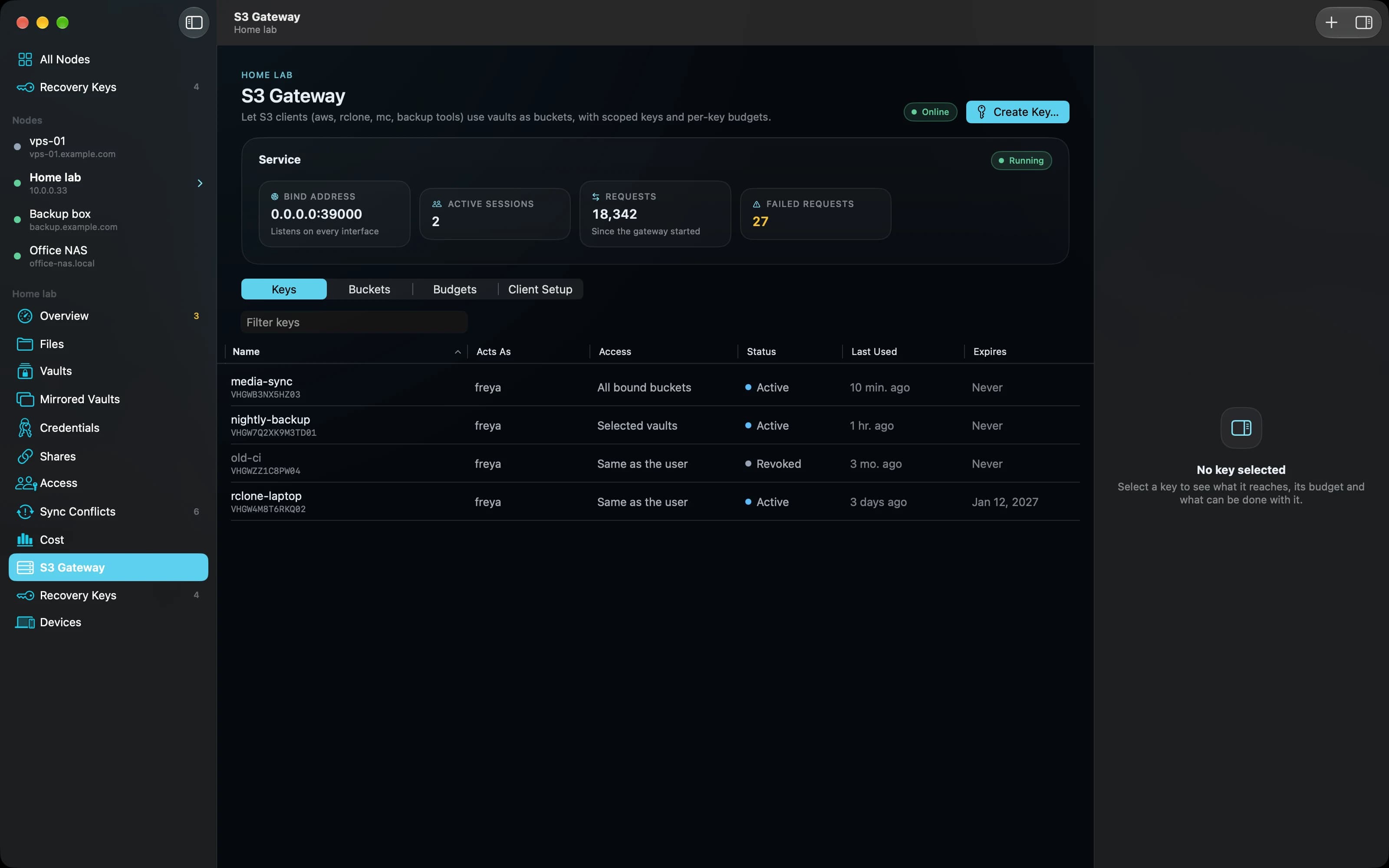
Path-glob allow and deny overrides, expiry and per-key monthly budgets narrow a key further. The user's permissions are always the ceiling: allowed = principal RBAC ∧ scope rules ∧ budget preflight. Vaulthalla Desktop manages gateway keys too.

Credentials and scopes
Vaulthalla Desktop's S3 Gateway page: service status, request counts and the scoped access keys that let S3 tools use vaults as buckets

Endpoint

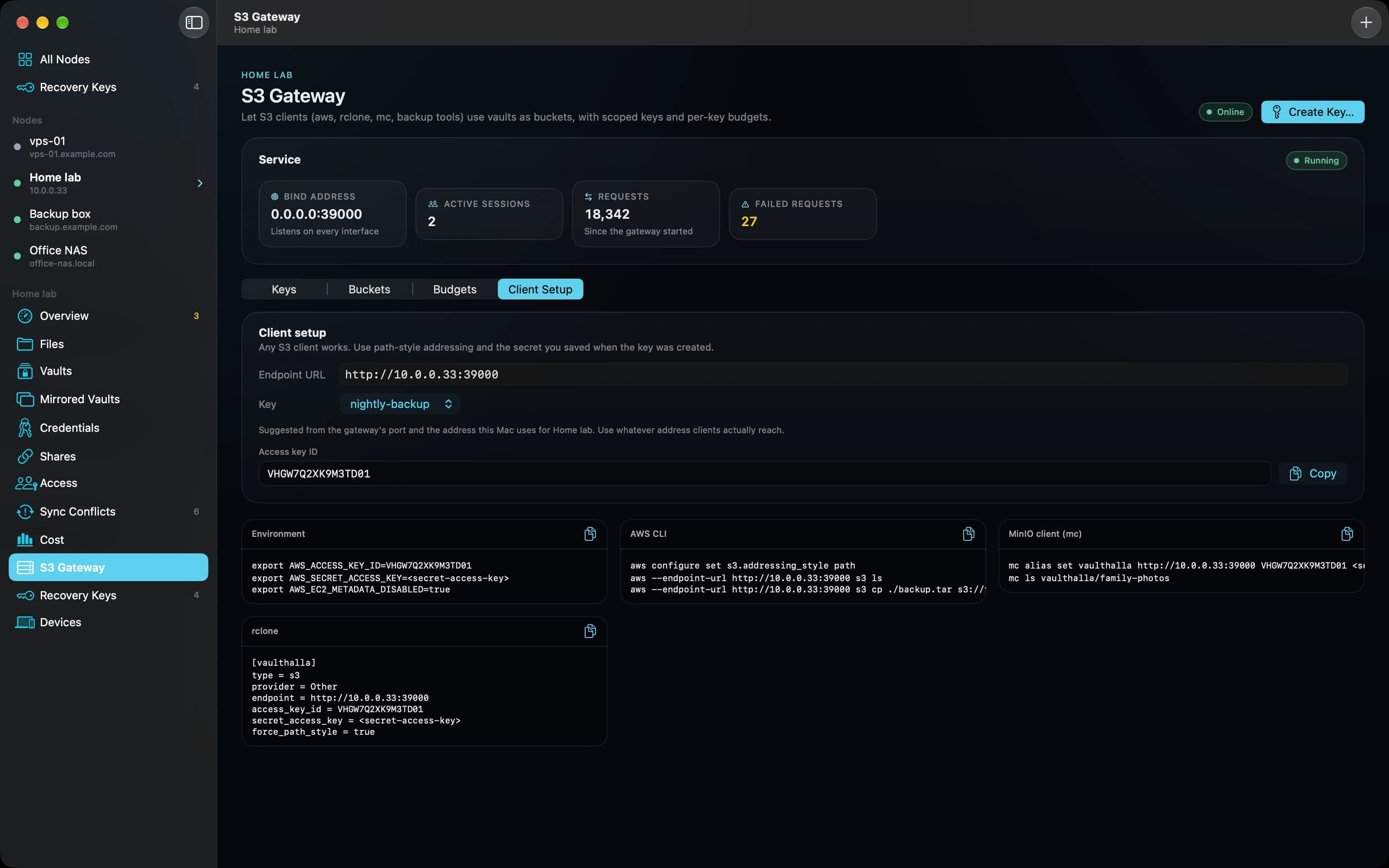
An HTTPS endpoint in one command

The direct listener binds 127.0.0.1:39000 over plain HTTP, loopback only by default. vh setup nginx --s3-domain puts a managed HTTPS hostname in front of it, and Cloudflare DNS-01 works for hosts that only live on your LAN. Caddy is the front end on macOS.

Path-style addressing is the default, and virtual-hosted style is optional on the direct listener. Vaulthalla Desktop shows the endpoint with ready-to-copy settings for the AWS CLI, rclone, the MinIO client and environment variables.

Gateway setup
Vaulthalla Desktop's S3 Gateway client setup: endpoint, access key and ready-to-copy settings for the AWS CLI, rclone, the MinIO client and environment variables

Encrypted at rest, with a key per vault

Encryption is not a bucket setting you remember to turn on. Every vault has its own AES-256-GCM key, versioned and wrapped by a master key sealed in the TPM on Linux or the Secure Enclave on a Mac.

Authenticated chunks

Files are stored as 64 KiB AES-256-GCM chunks, each authenticated. Truncation, reordering and splicing are refused, and a range read authenticates every byte it returns.

No plaintext in flight

S3 request bodies and multipart parts are encrypted on arrival, under an in-memory per-boot key or the vault key, so they never sit on disk in plaintext.

Who can read it

Whoever administers the server can read everything on it. File names are kept in PostgreSQL, so keep full-disk encryption on. Valkyrian Labs receives no keys.

Replacing MinIO

If you are moving off MinIO

Many people searching for self-hosted S3 are replacing MinIO's community edition. The dated facts: it became source-only on October 15, 2025, entered maintenance mode on December 3, 2025, and its repository was archived on April 25, 2026. Prebuilt MinIO now ships as the commercial AIStor, whose Free tier (announced December 23, 2025) is single-node and needs a license key. MinIO is still the stronger choice for distributed, erasure-coded storage. The full comparison.

  • YesYes
  • PartlyPartly
  • NoNo
  • PlannedPlanned
  • Not applicableNot applicable
Vaulthalla compared with MinIO
DimensionVaulthallaStorage platformServer 1.28.1, Desktop 0.7.0MinIOObject storeCommunity edition and AIStor
Ownership
Self-hosting and infrastructure ownership

Both run on your own hardware. As of 28 November 2026 the community edition repository is archived and ships no binaries; prebuilt MinIO comes as AIStor, which needs a license key.

YesRuns on hardware you own

One daemon plus PostgreSQL, with nginx or Caddy in front, on a Linux server or a Mac you run. 12

YesRuns on hardware you own

Community edition is source-only since 15 October 2025 and archived since 25 April 2026. AIStor Free is single-node; multi-node needs a paid AIStor tier. 34

Open-source license

The MinIO pricing page calls the AGPL edition end-of-life with no new features, bug fixes or security patches. Vaulthalla’s releases ship from its AGPL repositories.

YesAGPL-3.0-or-later

Server and Desktop are public under AGPL-3.0-or-later. Shared libraries such as vl-sigv4 are MIT. 56

PartlyArchived AGPL edition; AIStor proprietary

Community edition stays AGPL-3.0 but its repository is archived. AIStor is a commercial product sold as a term license. 37

Runs without a vendor account or telemetry

A Vaulthalla server keeps running with no license key to renew.

YesNo account, no telemetry

Running it needs no account with Valkyrian Labs, and it sends no telemetry. A password breach lookup runs when a password is set. 58

PartlyAIStor Free needs a license key

Community edition needs no account. AIStor needs a license key and offers optional Call Home Diagnostics. 37

Encryption and keys
Encryption at rest and toward the storage provider

Both encrypt on the server. Vaulthalla seals its keys with TPM2 or the Secure Enclave and needs no separate key server; MinIO uses an external key manager.

YesOn by default, every vault

Every vault has its own AES-256-GCM key, and bucket-backed vaults encrypt each file before upload. Upstream encryption can be turned off per vault. 9

PartlyServer-side, with a key manager

SSE-S3 and SSE-KMS need MinIO KMS or KES; the open-source KES was archived in May 2025. MinIO recommends against SSE-C in production. 101112

Who holds the keys

In both, the server uses the keys and the person who runs it controls them.

YesYou, on your own server

Keys are sealed by TPM2 on Linux or the Secure Enclave on macOS; Valkyrian Labs receives none. Whoever administers the server can read its vaults. 913

PartlyYour KMS, used by the server

You run the key manager, and the MinIO server holds and uses the keys to encrypt objects. 10

File names and metadata hidden from the provider

This matters when the bucket is rented. Vaulthalla can sit in front of B2, R2 or AWS so the provider sees only opaque objects; MinIO is the bucket.

YesOpaque object names by default

Your storage provider only ever sees encrypted, opaquely named objects. It can’t see your file names, folders or contents. It can see how many objects you store, their sizes and when they change. 98

Not applicableYou are the provider

MinIO stores objects on drives you run, so there is no separate storage provider. Server-side encryption covers object contents. 10

Files, S3 and storage
Native filesystem and desktop integration

Vaulthalla serves the same vault as files, as a Finder location and as S3. MinIO serves S3 only.

YesFinder on the Mac, FUSE on Linux

Vaulthalla Desktop puts vaults in Finder with on-demand downloads and Keep Downloaded. On Linux the server mounts vaults at /mnt/vaulthalla. 614

Not applicableObject store, reached over S3

MinIO is an S3 object store; files are reached through S3 clients and tools. 15

S3-compatible API served to clients

MinIO implements far more of the S3 API. Vaulthalla covers the everyday operations and states its gaps: no IAM or bucket policies, versioning API, lifecycle, object lock, STS or SigV4a.

YesBuilt-in S3 gateway

Bucket, object and multipart operations with SigV4 and presigned URLs, tested with AWS CLI, boto3, rclone and mc. No bucket policies, versioning API, lifecycle or object lock. 161718

YesThe core product

A broad S3 API, including versioning, object lock, replication and IAM policies. 151920

Upstream providers and bring your own storage

MinIO is where objects live. Vaulthalla is built to put your endpoint in front of storage you rent, and to change providers without changing clients.

YesAny S3-compatible bucket you own

AWS S3, Cloudflare R2 and Backblaze B2 get full bucket administration; other S3-compatible buckets work as vault storage. Attach or detach a bucket in place. 2122

PartlyLocal drives; tiering to remote targets

MinIO stores objects on local drives and can move objects to remote targets with lifecycle tiering. 23

Gateway, local copies, upstream sync and server mirroring

MinIO replicates between MinIO clusters. Vaulthalla fronts other providers, the role MinIO’s gateway mode had before 2022, and mirrors a vault as one core plus one copy.

YesGateway, cache, sync and mirrored vaults

Gateway buckets can keep a local copy or proxy straight through, with budgets that stall instead of overspending. Mirrored vaults (1.27.1) keep a full copy on a second server. 242526

PartlyReplication between MinIO sites

Bucket and site replication work between MinIO deployments and need versioning. Gateway mode for other storage was removed in 2022. 2027

Recovery, access and agents
Independent disaster recovery and key recovery

A Vaulthalla vault carries its wrapped keys in its own bucket, so recovery needs the bucket and your kit, not a second key system. Users, roles and shares need the database backup.

YesRestore from bucket and recovery kit

Restore from your bucket and your recovery kit into a server you run, even if the old one is gone. No account or payment needed. 1328

PartlyReplication; back up the KMS separately

Replication and object lock protect data across sites. The key manager is a separate system to back up. 2010

Granular permissions and scoped credentials

MinIO has a full IAM policy language. Vaulthalla uses roles, path overrides and key scopes, with the user’s own permissions as the ceiling.

YesRoles, path overrides, scoped keys

Admin and vault roles with path overrides, S3 keys scoped to vaults with expiry, and devices scoped read-only (1.24.0). No IAM policy language. 293031

YesIAM policies, STS, OIDC and LDAP

Policy-based access with service accounts, STS and external identity providers. The community console lost identity-provider login on 24 May 2025. 3233

MCP and AI agents with permission gates

Both gate writes. Vaulthalla’s agents get the same permissions as the account they act for, with approval before destructive commands.

YesMCP with approval for destructive steps

Agents act as your account and never beyond it, destructive commands wait for a person’s approval, and keys are never reachable. Desktop sets up Claude and Codex in one click. 3435

PartlyAIStor MCP; public repository archived

The AIStor MCP server is read-only by default, with flags to allow write, delete and admin tools. Its public repository has had no changes since May 2025 and is archived. 3615

Where others lead
Clustering, erasure coding, object lock, IAM and scale

For many nodes, erasure coding, compliance retention or very large scale, MinIO AIStor is built for the job and Vaulthalla is not.

NoNot built

No erasure coding, multi-node cluster, object lock or IAM policies. A mirrored vault is one core plus one copy, not a quorum. 1826

YesErasure coding, object lock, IAM

Erasure coding across many nodes, object lock, site replication and IAM policies; AIStor claims exabyte scale. Multi-node needs a paid AIStor tier. 3719415

Ownership

Self-hosting and infrastructure ownership

Both run on your own hardware. As of 28 November 2026 the community edition repository is archived and ships no binaries; prebuilt MinIO comes as AIStor, which needs a license key.

VaulthallaYesRuns on hardware you own
MinIOYesRuns on hardware you own
Notes and sources
Vaulthalla
One daemon plus PostgreSQL, with nginx or Caddy in front, on a Linux server or a Mac you run. 12
MinIO
Community edition is source-only since 15 October 2025 and archived since 25 April 2026. AIStor Free is single-node; multi-node needs a paid AIStor tier. 34

Open-source license

The MinIO pricing page calls the AGPL edition end-of-life with no new features, bug fixes or security patches. Vaulthalla’s releases ship from its AGPL repositories.

VaulthallaYesAGPL-3.0-or-later
MinIOPartlyArchived AGPL edition; AIStor proprietary
Notes and sources
Vaulthalla
Server and Desktop are public under AGPL-3.0-or-later. Shared libraries such as vl-sigv4 are MIT. 56
MinIO
Community edition stays AGPL-3.0 but its repository is archived. AIStor is a commercial product sold as a term license. 37

Runs without a vendor account or telemetry

A Vaulthalla server keeps running with no license key to renew.

VaulthallaYesNo account, no telemetry
MinIOPartlyAIStor Free needs a license key
Notes and sources
Vaulthalla
Running it needs no account with Valkyrian Labs, and it sends no telemetry. A password breach lookup runs when a password is set. 58
MinIO
Community edition needs no account. AIStor needs a license key and offers optional Call Home Diagnostics. 37

Encryption and keys

Encryption at rest and toward the storage provider

Both encrypt on the server. Vaulthalla seals its keys with TPM2 or the Secure Enclave and needs no separate key server; MinIO uses an external key manager.

VaulthallaYesOn by default, every vault
MinIOPartlyServer-side, with a key manager
Notes and sources
Vaulthalla
Every vault has its own AES-256-GCM key, and bucket-backed vaults encrypt each file before upload. Upstream encryption can be turned off per vault. 9
MinIO
SSE-S3 and SSE-KMS need MinIO KMS or KES; the open-source KES was archived in May 2025. MinIO recommends against SSE-C in production. 101112

Who holds the keys

In both, the server uses the keys and the person who runs it controls them.

VaulthallaYesYou, on your own server
MinIOPartlyYour KMS, used by the server
Notes and sources
Vaulthalla
Keys are sealed by TPM2 on Linux or the Secure Enclave on macOS; Valkyrian Labs receives none. Whoever administers the server can read its vaults. 913
MinIO
You run the key manager, and the MinIO server holds and uses the keys to encrypt objects. 10

File names and metadata hidden from the provider

This matters when the bucket is rented. Vaulthalla can sit in front of B2, R2 or AWS so the provider sees only opaque objects; MinIO is the bucket.

VaulthallaYesOpaque object names by default
MinIONot applicableYou are the provider
Notes and sources
Vaulthalla
Your storage provider only ever sees encrypted, opaquely named objects. It can’t see your file names, folders or contents. It can see how many objects you store, their sizes and when they change. 98
MinIO
MinIO stores objects on drives you run, so there is no separate storage provider. Server-side encryption covers object contents. 10

Files, S3 and storage

Native filesystem and desktop integration

Vaulthalla serves the same vault as files, as a Finder location and as S3. MinIO serves S3 only.

VaulthallaYesFinder on the Mac, FUSE on Linux
MinIONot applicableObject store, reached over S3
Notes and sources
Vaulthalla
Vaulthalla Desktop puts vaults in Finder with on-demand downloads and Keep Downloaded. On Linux the server mounts vaults at /mnt/vaulthalla. 614
MinIO
MinIO is an S3 object store; files are reached through S3 clients and tools. 15

S3-compatible API served to clients

MinIO implements far more of the S3 API. Vaulthalla covers the everyday operations and states its gaps: no IAM or bucket policies, versioning API, lifecycle, object lock, STS or SigV4a.

VaulthallaYesBuilt-in S3 gateway
MinIOYesThe core product
Notes and sources
Vaulthalla
Bucket, object and multipart operations with SigV4 and presigned URLs, tested with AWS CLI, boto3, rclone and mc. No bucket policies, versioning API, lifecycle or object lock. 161718
MinIO
A broad S3 API, including versioning, object lock, replication and IAM policies. 151920

Upstream providers and bring your own storage

MinIO is where objects live. Vaulthalla is built to put your endpoint in front of storage you rent, and to change providers without changing clients.

VaulthallaYesAny S3-compatible bucket you own
MinIOPartlyLocal drives; tiering to remote targets
Notes and sources
Vaulthalla
AWS S3, Cloudflare R2 and Backblaze B2 get full bucket administration; other S3-compatible buckets work as vault storage. Attach or detach a bucket in place. 2122
MinIO
MinIO stores objects on local drives and can move objects to remote targets with lifecycle tiering. 23

Gateway, local copies, upstream sync and server mirroring

MinIO replicates between MinIO clusters. Vaulthalla fronts other providers, the role MinIO’s gateway mode had before 2022, and mirrors a vault as one core plus one copy.

VaulthallaYesGateway, cache, sync and mirrored vaults
MinIOPartlyReplication between MinIO sites
Notes and sources
Vaulthalla
Gateway buckets can keep a local copy or proxy straight through, with budgets that stall instead of overspending. Mirrored vaults (1.27.1) keep a full copy on a second server. 242526
MinIO
Bucket and site replication work between MinIO deployments and need versioning. Gateway mode for other storage was removed in 2022. 2027

Recovery, access and agents

Independent disaster recovery and key recovery

A Vaulthalla vault carries its wrapped keys in its own bucket, so recovery needs the bucket and your kit, not a second key system. Users, roles and shares need the database backup.

VaulthallaYesRestore from bucket and recovery kit
MinIOPartlyReplication; back up the KMS separately
Notes and sources
Vaulthalla
Restore from your bucket and your recovery kit into a server you run, even if the old one is gone. No account or payment needed. 1328
MinIO
Replication and object lock protect data across sites. The key manager is a separate system to back up. 2010

Granular permissions and scoped credentials

MinIO has a full IAM policy language. Vaulthalla uses roles, path overrides and key scopes, with the user’s own permissions as the ceiling.

VaulthallaYesRoles, path overrides, scoped keys
MinIOYesIAM policies, STS, OIDC and LDAP
Notes and sources
Vaulthalla
Admin and vault roles with path overrides, S3 keys scoped to vaults with expiry, and devices scoped read-only (1.24.0). No IAM policy language. 293031
MinIO
Policy-based access with service accounts, STS and external identity providers. The community console lost identity-provider login on 24 May 2025. 3233

MCP and AI agents with permission gates

Both gate writes. Vaulthalla’s agents get the same permissions as the account they act for, with approval before destructive commands.

VaulthallaYesMCP with approval for destructive steps
MinIOPartlyAIStor MCP; public repository archived
Notes and sources
Vaulthalla
Agents act as your account and never beyond it, destructive commands wait for a person’s approval, and keys are never reachable. Desktop sets up Claude and Codex in one click. 3435
MinIO
The AIStor MCP server is read-only by default, with flags to allow write, delete and admin tools. Its public repository has had no changes since May 2025 and is archived. 3615

Where others lead

Clustering, erasure coding, object lock, IAM and scale

For many nodes, erasure coding, compliance retention or very large scale, MinIO AIStor is built for the job and Vaulthalla is not.

VaulthallaNoNot built
MinIOYesErasure coding, object lock, IAM
Notes and sources
Vaulthalla
No erasure coding, multi-node cluster, object lock or IAM policies. A mirrored vault is one core plus one copy, not a quorum. 1826
MinIO
Erasure coding across many nodes, object lock, site replication and IAM policies; AIStor claims exabyte scale. Multi-node needs a paid AIStor tier. 3719415

Choose MinIO if

  • You need erasure coding across many nodes, or very large scale.
  • You need object lock, versioning, lifecycle rules or IAM policies through the S3 API.
  • You replicate between object storage sites.
  • You want a vendor subscription with a support SLA (AIStor Enterprise).

Choose Vaulthalla if

  • You want an AGPL S3 endpoint on one machine, with files, sharing and a Mac app beside it.
  • You want your own endpoint in front of B2, R2 or AWS, with local copies and spend budgets.
  • You want file contents and names encrypted before they reach a rented bucket.
  • You want vault keys sealed on the host and recoverable with a kit, without a separate key server.

What it is not

Vaulthalla is one server with an S3 endpoint into your vaults. It is not a distributed object store.

  • One server. No erasure coding, no clustering and no multi-node object store. A mirrored vault is one core plus one copy on a second server, not a quorum.
  • No IAM policy language. No bucket policies, ACLs, STS session tokens or SigV4a. Access is roles, key scopes and path overrides.
  • No object lock or versioning API. No legal hold, MFA delete or lifecycle rules, and no bucket configuration such as replication, notifications, CORS, website, tagging or logging. Multi-range GET answers 501.
  • Two platforms. Linux amd64 (Ubuntu 24.04 tested) and macOS 14 or later on Apple Silicon. No ARM Linux, Intel Mac or Windows.

Choose a distributed object store instead when you need capacity and throughput spread across many nodes, data that survives disk and node loss through erasure coding, object lock for compliance retention, IAM policies for many applications, site replication or a Kubernetes operator. Choose Vaulthalla when one server is the right size, and the S3 endpoint is one of several ways into the same encrypted files. All S3 limitations

FAQ

Questions about self-hosted S3

Is Vaulthalla a drop-in MinIO replacement?

For a single server serving the core S3 operations to tools like the AWS CLI, boto3, rclone or mc, it covers the same ground. It is not a replacement where you rely on erasure coding, clusters, IAM policies, object lock or versioning. Vaulthalla and MinIO.

Which S3 clients work with it?

AWS CLI, boto3, rclone and MinIO mc have how-tos and smoke tests, and the AWS Java SDK is documented for its signing mode. Client setup.

Does it support presigned URLs and multipart uploads?

Yes. Presigned URLs work (X-Amz-Expires=0 is refused), and multipart uploads support create, upload part, complete, abort and ListMultipartUploads, with parts encrypted at rest.

Can I use it as a backup target?

S3-aware backup tools that use the supported operations can write to it, ideally with a scoped key and a budget. No backup product is named as tested, and there is no object lock, so immutability has to come from somewhere else.

Is data encrypted at rest?

Yes, always. Each vault has its own AES-256-GCM key, wrapped by a master key that the TPM seals on Linux and the Secure Enclave seals on a Mac. Whoever administers the server can still read everything on it.

Does it run on a Raspberry Pi or other ARM board?

No. The server runs on Linux amd64 and on macOS 14 or later on Apple Silicon.

How do I expose the endpoint over HTTPS on my LAN?

Run vh setup nginx --s3-domain for a managed HTTPS hostname; Cloudflare DNS-01 issues certificates for hosts that are not reachable from the internet. Gateway setup.

An airship eases into a lantern-lit port through the fog while dock crews wait below

Self-hosted S3

Point your S3 tools home

Install the server, create a vault, and give your scripts and backup jobs a scoped key to an endpoint on your own hardware.