
Skip to content
Vaulthalla LogoVaulthalla

Vaulthalla vs MinIO

An S3 endpoint you own, with your files and keys beside it

MinIO is a distributed object store, now sold as AIStor. Vaulthalla is a storage platform with an S3 gateway built in: one server, encrypted vaults behind buckets, and the same files in Finder and the web console.

  • AGPL-3.0-or-later, released from public repositories
  • Tested with AWS CLI, boto3, rclone and mc
  • Your endpoint in front of B2, R2 or AWS
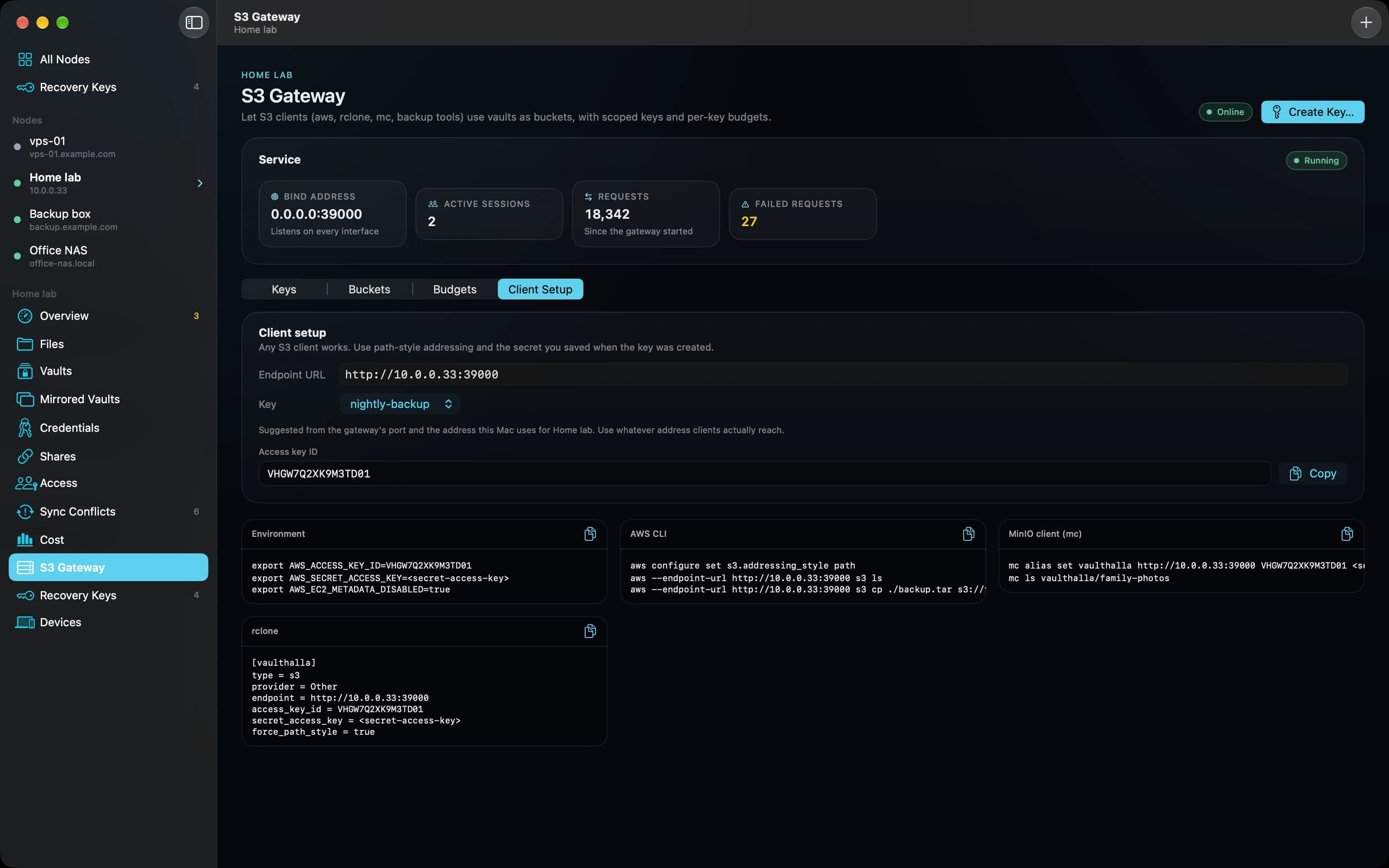
S3 Gateway client setup in Vaulthalla Desktop: endpoint, access key and ready-to-copy settings for the AWS CLI, rclone and the MinIO client

Where MinIO stands, as of November 28, 2026

From MinIO's own repository, release notes, blog and pricing page.

Date What changed
February and October 2022 Gateway mode, which put MinIO's S3 API in front of NAS, HDFS, Azure, GCS and S3, is deprecated, then removed in RELEASE.2022-10-29T06-21-33Z.
May 24, 2025 Release notes: the embedded console is deprecated and moved to a separate object browser, and LDAP and OIDC logins are removed from the community edition and offered in AIStor. STS APIs keep working.
May 2025 KES, MinIO's open-source key server, is archived as no longer maintained.
October 15, 2025 README: the community edition is distributed as source code only, with no pre-compiled binaries. The last GitHub release is RELEASE.2025-10-15T17-29-55Z.
December 3, 2025 README: maintenance mode. No new features or pull requests; critical security fixes may be evaluated case by case.
December 23, 2025 AIStor tiers announced: Free (single node only), Enterprise Lite (multi-node, under 400 TiB) and Enterprise (unlimited, 24/7 support, response under 4 hours).
January 6, 2026 README points to AIStor Free, which needs a downloaded license key, and AIStor Enterprise.
February 12, 2026 README: the repository is no longer maintained.
March 19 to April 25, 2026 Seven security advisories (five high, two medium) are published. Fixes ship in RELEASE.2026-04-11T03-20-12Z and later, which is not a community release.
April 25, 2026 The repository is archived (read-only). The code remains AGPL-3.0.

MinIO's pricing page describes the AGPL edition as end-of-life, with no new features, bug fixes or security patches. AIStor is a commercial product, priced by quote on usable capacity and sold as a term license. Community forks exist, such as pgsty's Silo, which restores the console and binary builds.

Row by row

An object store and a storage platform

Both put an S3 API on hardware you run. The rows below show where they differ, checked on November 28, 2026.

  • YesYes
  • PartlyPartly
  • NoNo
  • PlannedPlanned
  • Not applicableNot applicable
Vaulthalla compared with MinIO
DimensionVaulthallaStorage platformServer 1.28.1, Desktop 0.7.0MinIOObject storeCommunity edition and AIStor
Ownership
Self-hosting and infrastructure ownership

Both run on your own hardware. As of 28 November 2026 the community edition repository is archived and ships no binaries; prebuilt MinIO comes as AIStor, which needs a license key.

YesRuns on hardware you own

One daemon plus PostgreSQL, with nginx or Caddy in front, on a Linux server or a Mac you run. 12

YesRuns on hardware you own

Community edition is source-only since 15 October 2025 and archived since 25 April 2026. AIStor Free is single-node; multi-node needs a paid AIStor tier. 34

Open-source license

The MinIO pricing page calls the AGPL edition end-of-life with no new features, bug fixes or security patches. Vaulthalla’s releases ship from its AGPL repositories.

YesAGPL-3.0-or-later

Server and Desktop are public under AGPL-3.0-or-later. Shared libraries such as vl-sigv4 are MIT. 56

PartlyArchived AGPL edition; AIStor proprietary

Community edition stays AGPL-3.0 but its repository is archived. AIStor is a commercial product sold as a term license. 37

Runs without a vendor account or telemetry

A Vaulthalla server keeps running with no license key to renew.

YesNo account, no telemetry

Running it needs no account with Valkyrian Labs, and it sends no telemetry. A password breach lookup runs when a password is set. 58

PartlyAIStor Free needs a license key

Community edition needs no account. AIStor needs a license key and offers optional Call Home Diagnostics. 37

Encryption and keys
Encryption at rest and toward the storage provider

Both encrypt on the server. Vaulthalla seals its keys with TPM2 or the Secure Enclave and needs no separate key server; MinIO uses an external key manager.

YesOn by default, every vault

Every vault has its own AES-256-GCM key, and bucket-backed vaults encrypt each file before upload. Upstream encryption can be turned off per vault. 9

PartlyServer-side, with a key manager

SSE-S3 and SSE-KMS need MinIO KMS or KES; the open-source KES was archived in May 2025. MinIO recommends against SSE-C in production. 101112

Who holds the keys

In both, the server uses the keys and the person who runs it controls them.

YesYou, on your own server

Keys are sealed by TPM2 on Linux or the Secure Enclave on macOS; Valkyrian Labs receives none. Whoever administers the server can read its vaults. 913

PartlyYour KMS, used by the server

You run the key manager, and the MinIO server holds and uses the keys to encrypt objects. 10

File names and metadata hidden from the provider

This matters when the bucket is rented. Vaulthalla can sit in front of B2, R2 or AWS so the provider sees only opaque objects; MinIO is the bucket.

YesOpaque object names by default

Your storage provider only ever sees encrypted, opaquely named objects. It can’t see your file names, folders or contents. It can see how many objects you store, their sizes and when they change. 98

Not applicableYou are the provider

MinIO stores objects on drives you run, so there is no separate storage provider. Server-side encryption covers object contents. 10

Files, S3 and storage
Native filesystem and desktop integration

Vaulthalla serves the same vault as files, as a Finder location and as S3. MinIO serves S3 only.

YesFinder on the Mac, FUSE on Linux

Vaulthalla Desktop puts vaults in Finder with on-demand downloads and Keep Downloaded. On Linux the server mounts vaults at /mnt/vaulthalla. 614

Not applicableObject store, reached over S3

MinIO is an S3 object store; files are reached through S3 clients and tools. 15

S3-compatible API served to clients

MinIO implements far more of the S3 API. Vaulthalla covers the everyday operations and states its gaps: no IAM or bucket policies, versioning API, lifecycle, object lock, STS or SigV4a.

YesBuilt-in S3 gateway

Bucket, object and multipart operations with SigV4 and presigned URLs, tested with AWS CLI, boto3, rclone and mc. No bucket policies, versioning API, lifecycle or object lock. 161718

YesThe core product

A broad S3 API, including versioning, object lock, replication and IAM policies. 151920

Upstream providers and bring your own storage

MinIO is where objects live. Vaulthalla is built to put your endpoint in front of storage you rent, and to change providers without changing clients.

YesAny S3-compatible bucket you own

AWS S3, Cloudflare R2 and Backblaze B2 get full bucket administration; other S3-compatible buckets work as vault storage. Attach or detach a bucket in place. 2122

PartlyLocal drives; tiering to remote targets

MinIO stores objects on local drives and can move objects to remote targets with lifecycle tiering. 23

Gateway, local copies, upstream sync and server mirroring

MinIO replicates between MinIO clusters. Vaulthalla fronts other providers, the role MinIO’s gateway mode had before 2022, and mirrors a vault as one core plus one copy.

YesGateway, cache, sync and mirrored vaults

Gateway buckets can keep a local copy or proxy straight through, with budgets that stall instead of overspending. Mirrored vaults (1.27.1) keep a full copy on a second server. 242526

PartlyReplication between MinIO sites

Bucket and site replication work between MinIO deployments and need versioning. Gateway mode for other storage was removed in 2022. 2027

Recovery, access and agents
Independent disaster recovery and key recovery

A Vaulthalla vault carries its wrapped keys in its own bucket, so recovery needs the bucket and your kit, not a second key system. Users, roles and shares need the database backup.

YesRestore from bucket and recovery kit

Restore from your bucket and your recovery kit into a server you run, even if the old one is gone. No account or payment needed. 1328

PartlyReplication; back up the KMS separately

Replication and object lock protect data across sites. The key manager is a separate system to back up. 2010

Granular permissions and scoped credentials

MinIO has a full IAM policy language. Vaulthalla uses roles, path overrides and key scopes, with the user’s own permissions as the ceiling.

YesRoles, path overrides, scoped keys

Admin and vault roles with path overrides, S3 keys scoped to vaults with expiry, and devices scoped read-only (1.24.0). No IAM policy language. 293031

YesIAM policies, STS, OIDC and LDAP

Policy-based access with service accounts, STS and external identity providers. The community console lost identity-provider login on 24 May 2025. 3233

MCP and AI agents with permission gates

Both gate writes. Vaulthalla’s agents get the same permissions as the account they act for, with approval before destructive commands.

YesMCP with approval for destructive steps

Agents act as your account and never beyond it, destructive commands wait for a person’s approval, and keys are never reachable. Desktop sets up Claude and Codex in one click. 3435

PartlyAIStor MCP; public repository archived

The AIStor MCP server is read-only by default, with flags to allow write, delete and admin tools. Its public repository has had no changes since May 2025 and is archived. 3615

Where others lead
Clustering, erasure coding, object lock, IAM and scale

For many nodes, erasure coding, compliance retention or very large scale, MinIO AIStor is built for the job and Vaulthalla is not.

NoNot built

No erasure coding, multi-node cluster, object lock or IAM policies. A mirrored vault is one core plus one copy, not a quorum. 1826

YesErasure coding, object lock, IAM

Erasure coding across many nodes, object lock, site replication and IAM policies; AIStor claims exabyte scale. Multi-node needs a paid AIStor tier. 3719415

Ownership

Self-hosting and infrastructure ownership

Both run on your own hardware. As of 28 November 2026 the community edition repository is archived and ships no binaries; prebuilt MinIO comes as AIStor, which needs a license key.

VaulthallaYesRuns on hardware you own
MinIOYesRuns on hardware you own
Notes and sources
Vaulthalla
One daemon plus PostgreSQL, with nginx or Caddy in front, on a Linux server or a Mac you run. 12
MinIO
Community edition is source-only since 15 October 2025 and archived since 25 April 2026. AIStor Free is single-node; multi-node needs a paid AIStor tier. 34

Open-source license

The MinIO pricing page calls the AGPL edition end-of-life with no new features, bug fixes or security patches. Vaulthalla’s releases ship from its AGPL repositories.

VaulthallaYesAGPL-3.0-or-later
MinIOPartlyArchived AGPL edition; AIStor proprietary
Notes and sources
Vaulthalla
Server and Desktop are public under AGPL-3.0-or-later. Shared libraries such as vl-sigv4 are MIT. 56
MinIO
Community edition stays AGPL-3.0 but its repository is archived. AIStor is a commercial product sold as a term license. 37

Runs without a vendor account or telemetry

A Vaulthalla server keeps running with no license key to renew.

VaulthallaYesNo account, no telemetry
MinIOPartlyAIStor Free needs a license key
Notes and sources
Vaulthalla
Running it needs no account with Valkyrian Labs, and it sends no telemetry. A password breach lookup runs when a password is set. 58
MinIO
Community edition needs no account. AIStor needs a license key and offers optional Call Home Diagnostics. 37

Encryption and keys

Encryption at rest and toward the storage provider

Both encrypt on the server. Vaulthalla seals its keys with TPM2 or the Secure Enclave and needs no separate key server; MinIO uses an external key manager.

VaulthallaYesOn by default, every vault
MinIOPartlyServer-side, with a key manager
Notes and sources
Vaulthalla
Every vault has its own AES-256-GCM key, and bucket-backed vaults encrypt each file before upload. Upstream encryption can be turned off per vault. 9
MinIO
SSE-S3 and SSE-KMS need MinIO KMS or KES; the open-source KES was archived in May 2025. MinIO recommends against SSE-C in production. 101112

Who holds the keys

In both, the server uses the keys and the person who runs it controls them.

VaulthallaYesYou, on your own server
MinIOPartlyYour KMS, used by the server
Notes and sources
Vaulthalla
Keys are sealed by TPM2 on Linux or the Secure Enclave on macOS; Valkyrian Labs receives none. Whoever administers the server can read its vaults. 913
MinIO
You run the key manager, and the MinIO server holds and uses the keys to encrypt objects. 10

File names and metadata hidden from the provider

This matters when the bucket is rented. Vaulthalla can sit in front of B2, R2 or AWS so the provider sees only opaque objects; MinIO is the bucket.

VaulthallaYesOpaque object names by default
MinIONot applicableYou are the provider
Notes and sources
Vaulthalla
Your storage provider only ever sees encrypted, opaquely named objects. It can’t see your file names, folders or contents. It can see how many objects you store, their sizes and when they change. 98
MinIO
MinIO stores objects on drives you run, so there is no separate storage provider. Server-side encryption covers object contents. 10

Files, S3 and storage

Native filesystem and desktop integration

Vaulthalla serves the same vault as files, as a Finder location and as S3. MinIO serves S3 only.

VaulthallaYesFinder on the Mac, FUSE on Linux
MinIONot applicableObject store, reached over S3
Notes and sources
Vaulthalla
Vaulthalla Desktop puts vaults in Finder with on-demand downloads and Keep Downloaded. On Linux the server mounts vaults at /mnt/vaulthalla. 614
MinIO
MinIO is an S3 object store; files are reached through S3 clients and tools. 15

S3-compatible API served to clients

MinIO implements far more of the S3 API. Vaulthalla covers the everyday operations and states its gaps: no IAM or bucket policies, versioning API, lifecycle, object lock, STS or SigV4a.

VaulthallaYesBuilt-in S3 gateway
MinIOYesThe core product
Notes and sources
Vaulthalla
Bucket, object and multipart operations with SigV4 and presigned URLs, tested with AWS CLI, boto3, rclone and mc. No bucket policies, versioning API, lifecycle or object lock. 161718
MinIO
A broad S3 API, including versioning, object lock, replication and IAM policies. 151920

Upstream providers and bring your own storage

MinIO is where objects live. Vaulthalla is built to put your endpoint in front of storage you rent, and to change providers without changing clients.

VaulthallaYesAny S3-compatible bucket you own
MinIOPartlyLocal drives; tiering to remote targets
Notes and sources
Vaulthalla
AWS S3, Cloudflare R2 and Backblaze B2 get full bucket administration; other S3-compatible buckets work as vault storage. Attach or detach a bucket in place. 2122
MinIO
MinIO stores objects on local drives and can move objects to remote targets with lifecycle tiering. 23

Gateway, local copies, upstream sync and server mirroring

MinIO replicates between MinIO clusters. Vaulthalla fronts other providers, the role MinIO’s gateway mode had before 2022, and mirrors a vault as one core plus one copy.

VaulthallaYesGateway, cache, sync and mirrored vaults
MinIOPartlyReplication between MinIO sites
Notes and sources
Vaulthalla
Gateway buckets can keep a local copy or proxy straight through, with budgets that stall instead of overspending. Mirrored vaults (1.27.1) keep a full copy on a second server. 242526
MinIO
Bucket and site replication work between MinIO deployments and need versioning. Gateway mode for other storage was removed in 2022. 2027

Recovery, access and agents

Independent disaster recovery and key recovery

A Vaulthalla vault carries its wrapped keys in its own bucket, so recovery needs the bucket and your kit, not a second key system. Users, roles and shares need the database backup.

VaulthallaYesRestore from bucket and recovery kit
MinIOPartlyReplication; back up the KMS separately
Notes and sources
Vaulthalla
Restore from your bucket and your recovery kit into a server you run, even if the old one is gone. No account or payment needed. 1328
MinIO
Replication and object lock protect data across sites. The key manager is a separate system to back up. 2010

Granular permissions and scoped credentials

MinIO has a full IAM policy language. Vaulthalla uses roles, path overrides and key scopes, with the user’s own permissions as the ceiling.

VaulthallaYesRoles, path overrides, scoped keys
MinIOYesIAM policies, STS, OIDC and LDAP
Notes and sources
Vaulthalla
Admin and vault roles with path overrides, S3 keys scoped to vaults with expiry, and devices scoped read-only (1.24.0). No IAM policy language. 293031
MinIO
Policy-based access with service accounts, STS and external identity providers. The community console lost identity-provider login on 24 May 2025. 3233

MCP and AI agents with permission gates

Both gate writes. Vaulthalla’s agents get the same permissions as the account they act for, with approval before destructive commands.

VaulthallaYesMCP with approval for destructive steps
MinIOPartlyAIStor MCP; public repository archived
Notes and sources
Vaulthalla
Agents act as your account and never beyond it, destructive commands wait for a person’s approval, and keys are never reachable. Desktop sets up Claude and Codex in one click. 3435
MinIO
The AIStor MCP server is read-only by default, with flags to allow write, delete and admin tools. Its public repository has had no changes since May 2025 and is archived. 3615

Where others lead

Clustering, erasure coding, object lock, IAM and scale

For many nodes, erasure coding, compliance retention or very large scale, MinIO AIStor is built for the job and Vaulthalla is not.

VaulthallaNoNot built
MinIOYesErasure coding, object lock, IAM
Notes and sources
Vaulthalla
No erasure coding, multi-node cluster, object lock or IAM policies. A mirrored vault is one core plus one copy, not a quorum. 1826
MinIO
Erasure coding across many nodes, object lock, site replication and IAM policies; AIStor claims exabyte scale. Multi-node needs a paid AIStor tier. 3719415

Choose MinIO if

  • You need erasure coding across many nodes, or very large scale.
  • You need object lock, versioning, lifecycle rules or IAM policies through the S3 API.
  • You replicate between object storage sites.
  • You want a vendor subscription with a support SLA (AIStor Enterprise).

Choose Vaulthalla if

  • You want an AGPL S3 endpoint on one machine, with files, sharing and a Mac app beside it.
  • You want your own endpoint in front of B2, R2 or AWS, with local copies and spend budgets.
  • You want file contents and names encrypted before they reach a rented bucket.
  • You want vault keys sealed on the host and recoverable with a kit, without a separate key server.

Different shapes

MinIO is a distributed object store: objects spread across drives and nodes with erasure coding, served over a broad S3 API and administered with the mc CLI. Applications reach it through S3 SDKs and tools.

Vaulthalla is a storage platform. Its unit is the vault: a set of files with its own encryption key, its own permissions and a home on local disk or in a bucket you own. The S3 gateway is one way into a vault. The web console, the Linux mount, Finder through Vaulthalla Desktop, the vh CLI and MCP for AI agents are others, and all of them answer to the same roles.

S3 API coverage

Area Vaulthalla gateway MinIO
Buckets and objects ListBuckets, Create, Head and DeleteBucket, ListObjectsV2 and v1, Get, Put, Head, Copy and DeleteObject, DeleteObjects Yes
Multipart uploads Yes; parts are encrypted at rest and survive restarts Yes
Signing and tokens SigV4, signed streaming uploads, presigned URLs SigV4, STS
Access control Roles, key scopes, path overrides and expiry IAM policies, service accounts, OIDC and LDAP
Versioning and lifecycle Not implemented (ListObjectVersions answers 501) Yes
Object lock and legal hold Not implemented Yes, with versioning
Replication Not through S3; mirrored vaults between Vaulthalla servers Bucket and site replication between MinIO deployments

The gateway also does not implement STS session tokens, SigV4a, multi-range GET, or bucket configuration such as notifications, CORS, website, tagging and logging. See gateway limitations.

Writes are local-first

A 200 from the gateway means the vault has the object. For a bucket-backed vault, sync uploads it to the provider afterwards, so the response does not yet prove the provider has it.

In practice

Scoped keys and everyday S3 tools

Every gateway key reaches only what you scope it to, and the user's own permissions are always the ceiling.

$ vh s3-gateway creds create backup --scope vault-allowlist --default-role contributor --selected-vault archive --json
# the secret is shown once and stored encrypted
$ vh s3-gateway budget set-key backup --monthly 5 --mode enforce --currency USD
# a hard monthly cap on what this key may spend upstream
$ aws configure set s3.addressing_style path
$ aws --endpoint-url https://s3.vault.example.com s3 sync ./photos s3://archive/photos
upload: photos/2026/harbor.jpg to s3://archive/photos/2026/harbor.jpg
upload: photos/2026/ridge.jpg to s3://archive/photos/2026/ridge.jpg
$ vh s3-gateway upstream create b2-archive --api-key b2-main --no-encrypt --sync-strategy mirror --on-sync-conflict keep_local
$ vh s3-gateway creds scope backup set --upstream b2-archive --allow-upstream r2-edge
$ aws s3api create-bucket --bucket reports --create-bucket-configuration LocationConstraint=r2-edge
# a real bucket is created in the R2 account behind the r2-edge profile

Commands from the S3 gateway docs. Clients with how-tos and smoke tests: AWS CLI, boto3, rclone and MinIO mc.

Encryption and keys

MinIO encrypts on the server. SSE-S3 and SSE-KMS need a key manager: MinIO KMS, or KES, whose open-source repository was archived in May 2025. SSE-C, where the client sends a key with each request, is supported, and MinIO recommends against it in production.

Vaulthalla encrypts every vault by default with its own AES-256-GCM key, wrapped by a master key that TPM2 seals on Linux and the Secure Enclave seals on a Mac, with no separate key server to run. Keys can be exported to a GPG recipient or wrapped to a recovery kit you create offline, and a bucket-backed vault keeps those wrapped key versions in its own bucket. When the vault lives in a rented bucket, your storage provider only ever sees encrypted, opaquely named objects. It can't see your file names, folders or contents. It can see how many objects you store, their sizes and when they change.

In both products the server holds and uses the keys, so whoever runs it can read the data. See encryption and keys and recovery.

Scale and durability

MinIO is built for scale: erasure sets with configurable parity across many drives and nodes, quorum reads and writes, site replication, and, in AIStor's words, "Exabyte Scale". AIStor Free is single node; multi-node AIStor is a paid tier, and the community edition that once ran multi-node is unmaintained.

Vaulthalla is one server. Its answer to losing that server is a mirrored vault: a linked second Vaulthalla server holds a full encrypted copy that follows every change in order, is checked step by step and scrubbed daily, and can take over when the core is gone. That is one core plus one copy, not a quorum, and there is no erasure coding. A vault can also live in a provider's bucket and keep an encrypted local copy. See the 1.27.1 release notes.

In front of rented storage

The job MinIO's gateway mode used to do

MinIO removed gateway mode in 2022. Vaulthalla's gateway puts your own endpoint in front of AWS S3, Cloudflare R2, Backblaze B2 and other S3-compatible buckets, with an encrypted local copy or straight proxying, upstream profiles chosen by region, and budgets that stall a job instead of overspending.

Own the endpoint, rent the storage

S3 clients such as the AWS CLI, rclone, boto3 and MinIO mc talk to one endpoint you own, s3.vault.example.com, on hardware you control. Each request is signed with a gateway key that carries a scope and an allowlist of upstream profiles. The request’s region or LocationConstraint selects the profile: b2-archive for Backblaze B2, r2-edge for Cloudflare R2, s3-main for AWS S3, or local for a local vault. A profile outside the key’s allowlist is refused. A plain CreateBucket under a profile creates a real private bucket in that provider account and binds it to a vault. Reads of files already held locally are served from the encrypted local copy with no upstream request. Writes land locally first and are synced upstream inside the budgets you set.

Any S3 client

Your tools, unchanged

AWS CLIrcloneboto3MinIO mc
SigV4
Hardware you control

Your endpoint

s3.vault.example.com

Gateway key backupscope vault-allowlistallow b2-archive, r2-edge, s3-main

Upstream profile

Picked per request

The region or LocationConstraint names the profile. Anything outside the key’s allowlist gets a 403.

Your storage provider
b2-archive

Backblaze B2

A bucket in your own account

r2-edge

Cloudflare R2

A bucket in your own account

s3-main

AWS S3

A bucket in your own account

local
Hardware you control

Local vault

Encrypted on this server

CreateBucket
A plain CreateBucket under a profile makes a real private bucket in that provider account and binds it to a vault.
GET
Files already held locally are served from the encrypted local copy, with no upstream request.
PUT
Writes land locally first, then sync upstream inside the budgets you set.

Clients keep one endpoint and one set of scoped keys, whichever provider holds each bucket. Existing non-empty buckets are never taken over. Gateway buckets and upstream profiles.

Where MinIO or another distributed object store is the better choice

Choose a distributed object store if you need erasure coding across many nodes, very large scale, object lock, versioning, lifecycle rules or IAM policies through the S3 API, replication between sites, or a vendor subscription with a support SLA. Vaulthalla does none of these. MinIO AIStor does them commercially (Free is single node; Enterprise Lite and Enterprise are multi-node), and several open-source projects work in the same space. Facts below as of November 28, 2026.

AGPL-3.0

Garage

Geo-distributed with three-zone replication and a 1 GB RAM minimum. Its S3 compatibility page lists no versioning, object lock or bucket policies. v2.6.0 on November 24, 2026.

Apache-2.0

SeaweedFS

S3 with versioning, object lock and lifecycle, a filer with FUSE, WebDAV and SFTP, background erasure coding and cross-cluster sync. Some features are Enterprise-only. v4.55 on November 23, 2026.

LGPL

Ceph RGW

S3 and Swift on a RADOS cluster, with SSE-C, SSE-KMS and SSE-S3.

Apache-2.0

RustFS

Written in Rust, distributed and erasure-coded, and positioned as a MinIO replacement. 1.0.7 on November 26, 2026.

Moving from MinIO

Objects copy over with the S3 tools you already use. Policies and users do not carry over: they become scoped gateway keys.

  1. Create vaults and bind buckets

    Create a vault for each bucket you move, on local disk or in a bucket you own, and bind a gateway bucket to it. See gateway buckets.

  2. Recreate credentials as scoped gateway keys

    Give each application its own key, scoped to the vaults it needs, with a default vault role, path overrides and an expiry where useful. See credentials and scopes.

  3. Copy the objects

    Point mc mirror or rclone at both endpoints. Object keys, Content-Type and x-amz-meta-* metadata are preserved.

    1mc alias set vaulthalla https://s3.vault.example.com <access-key> <secret-key>2mc mirror minio/archive vaulthalla/archive
  4. Check what does not carry over

    Bucket policies, versioning, lifecycle rules, object lock, STS and bucket notifications have no equivalent in the gateway. An application that depends on them needs a change or another home.

  5. Switch clients

    Change each application's endpoint and key, with path-style addressing, and keep the old deployment readable until you have checked the copies.

FAQ

Questions

Is the MinIO community edition still maintained?

As of November 28, 2026, no. Its README has said the repository is no longer maintained since February 12, 2026, the repository was archived on April 25, 2026, and prebuilt MinIO now ships as AIStor.

Is Vaulthalla a drop-in replacement for MinIO?

For applications that use everyday bucket, object and multipart operations with SigV4, often yes. Not for applications that rely on IAM or bucket policies, versioning, lifecycle rules, object lock or STS, which the gateway does not implement.

Does Vaulthalla do erasure coding or clustering?

No. Vaulthalla is one server per vault. A mirrored vault on a linked second server gives you a full encrypted copy that can take over, but it is one core plus one copy, not a quorum.

Can Vaulthalla run as a single-node S3 server?

Yes, that is its shape. The server runs on Linux amd64 or an Apple Silicon Mac, and the S3 gateway listens on 127.0.0.1:39000 until you give it an HTTPS hostname.

Which S3 clients work with Vaulthalla?

AWS CLI, boto3, rclone and MinIO mc have how-tos and smoke tests, and listings follow S3's ordering and pagination rules. See S3 clients.

Can Vaulthalla use an existing MinIO bucket as storage?

Yes, as plain vault storage within what the bucket supports. That lets you run both side by side while you move applications over.

Is Vaulthalla's S3 gateway open source?

Yes. Vaulthalla Server is AGPL-3.0-or-later, and its SigV4 signing library, vl-sigv4, is MIT.

The vault city and its perfect reflection on a wet salt flat

Own the endpoint

Move your buckets to an endpoint you own

Install the server, create a scoped key and sync a folder to your own endpoint with the AWS CLI. Your files show up in Finder and the web console too.